Most travelers choose a Masai Mara camp based on price, lodge style, or reputation. The off-road vs on-road game drive distinction rarely appears in brochures, yet it shapes the texture of every wildlife sighting you will have.
Understanding this rule split before you book changes what you look for in accommodation.
Where the Rules Diverge
Two separate systems govern vehicle movement in the Masai Mara ecosystem, and they produce different game drive experiences even when the wildlife on offer is identical.
Masai Mara National Reserve operates under a strict on-road policy. All vehicles must remain on defined dirt tracks at all times during a game drive. Guides cannot leave the track to approach a sighting from a better position, adjust for light direction, or follow an animal as it moves into open grass. Reserve rangers enforce the rule and violations carry fines.
Private conservancies (Olare Motorogi, Naboisho, Mara North, and others that share a boundary with the reserve) permit full off-road driving. A guide can travel anywhere within the conservancy: across open plains, along seasonal drainage channels, through light bush. There are no track restrictions. The guide reads terrain and animal behavior and places the vehicle wherever it needs to be.
This single policy difference produces fundamentally different sighting quality at identical wildlife encounters.
Why the Reserve Bans Off-Road Driving
The on-road rule is not administrative caution for its own sake. It exists because the national reserve receives hundreds of vehicles daily at peak season, and unrestricted off-road movement at that volume would systematically damage the grassland that supports the wildlife drawing visitors in the first place.
Habitat protection is the primary driver. Vehicles crossing grass compact soil, break root systems, and open erosion channels. Repeated uncontrolled access across the same terrain strips vegetation over time. The open savanna is not as resilient to mechanical pressure as it appears.
Wildlife disturbance is the secondary concern. Game tracks provide a spatial buffer between vehicles and sensitive wildlife: predators denning with cubs, ground-nesting birds, herbivores with newborns. Off-road access removes that buffer and concentrates vehicle pressure near exactly the animals most affected by it.
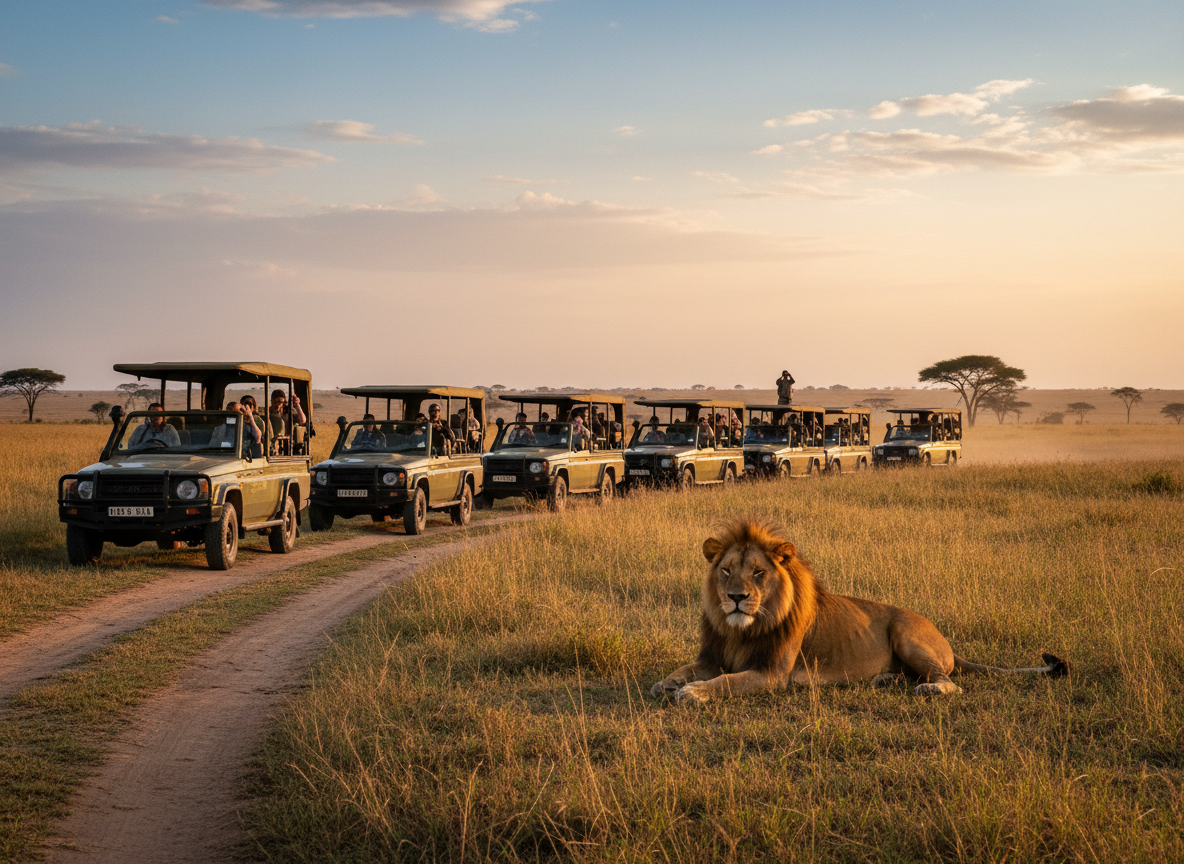
Vehicle equity at a sighting is the third factor. When off-road is permitted at high vehicle density, every guide at a sighting simultaneously pursues the best angle. A single lion sighting becomes a convergence of vehicles arriving from multiple directions at once, which benefits no one, including the lion.
The conservancy model solves all three problems through a different mechanism: guest bed caps keep vehicle numbers low, which makes off-road driving viable without the ecological and management consequences it would produce in a high-volume national reserve.
What On-Road Means at a Real Sighting
Consider a specific scenario. A guide in the national reserve spots a lion resting 50 metres off the track to the left.
The guide stops on the track. Guests view the lion from that fixed position. If the animal is side-lit, backlit, or partially screened by grass, that is the view available. Other vehicles receive radio notification and line up along the same track section. The group waits to see whether the lion moves toward the road.
What cannot happen: driving into the grass to close the distance, circling to the lit side of the animal, or following a hunting cheetah as it moves away across open ground.
Many reserve sightings are excellent. Animals do approach tracks, lions do sleep at the roadside, and cheetahs do hunt within clear view of the road. But when they choose not to, the on-road restriction is a hard ceiling on what the guide can offer.
What Off-Road Changes at the Same Sighting
In a conservancy with no track restriction, the same lion 50 metres off the road produces a different response.
The guide drives directly toward the sighting, reading the animal’s behavior while approaching. If the light is wrong, they circle to the other side. If the lion is relaxed, they close to photography distance. If the cat begins to move, the vehicle moves alongside it, across the grass, along a drainage line, into whatever terrain the animal enters.
A hunting cheetah on open plains can be followed across several kilometers. A leopard heading into riverine bush can be tracked to the trees. The sighting shifts from observational, watching from a fixed point, to something closer to participatory, moving with the event as it develops.
For photography, the practical difference is considerable. Off-road access lets the photographer manage light direction, control background clutter, maintain proximity to a moving subject, and work from a position the guide has chosen rather than one dictated by track location. That difference is not marginal.
Off-Road vs On-Road Game Drive: Side-by-Side
| Factor | National Reserve (On-Road) | Conservancy (Off-Road) |
|---|---|---|
| Vehicle stays on track | Yes | No |
| Approach angle to sighting | Fixed by track position | Fully flexible |
| Photography positioning | Limited by track | Guide-controlled |
| Follow moving animals | Only if they approach the road | Yes, across open terrain |
| Vehicle density at sighting | Multiple vehicles, same track | Often one vehicle only |
| Terrain access | Track corridor | Open plains and light bush |
| Why the rule exists | Protects habitat at high volume | Low guest caps make it viable |
Which Delivers Better Game Drive Quality?
For individual sighting quality, off-road access wins clearly. The combination of open-terrain driving and low guest bed caps in the conservancies produces wildlife encounters that track-restricted driving cannot replicate on the same terms.
But the national reserve offers something the conservancies cannot: scale. The reserve covers far more ground than any single conservancy. Its road network reaches the Mara River crossing points, the central open plains, and the Talek River corridor. The most dramatic wildebeest crossing viewing happens from established riverside positions that require no off-road access to reach.
Neither context makes the other irrelevant. Travelers who allocate nights in both, a conservancy for intimate daily game drives and a reserve camp for migration crossing access, get the widest range of experiences the Mara can offer.
If crossing season is not a priority or if photography is the main objective, the conservancy’s off-road access is usually the clearest deciding factor.
Explorer Notes
- Conservancy boundaries are specific. Confirm with your lodge whether your accommodation sits inside a conservancy or only adjacent to one. Adjacency does not grant off-road permission.
- Off-road driving in conservancies is not unmanaged. Guides read animal stress signals and maintain responsible distances. Low vehicle numbers make self-regulation practical and effective.
- Night game drives are typically available only in conservancies. The national reserve closes to vehicles at dusk.
- During the Great Migration (July to October), reserve drives along the Mara River are worth including regardless of off-road preference. Crossing viewings from the riverbank are among the most dramatic wildlife spectacles in East Africa.
- If you are undecided between reserve and conservancy accommodation, the off-road question is one of the clearest criteria available for distinguishing the two options in terms of daily game drive experience.
Two Systems, One Ecosystem
The off-road vs on-road game drive split is not a minor operational detail. It reflects two genuinely different approaches to wildlife access: one built for scale and managed volume, one built for intimacy and guide discretion.
Knowing which system your camp operates under is among the most useful pieces of pre-trip planning information available. The wildlife is the same on both sides of the boundary. The rules determine how close you get, from which direction, and whether your vehicle can stay with the action when it moves.
Every trip described here can be tailored: dates, budget, camps, and pace built around you.
Get a Personalised Safari